SLE
 Chemical Reactor Design Toolbox Reference Manual
Chemical Reactor Design Toolbox Reference Manual ChemReactorDesign.Basic.Liquid.Transfer.SLE
Description
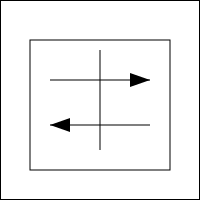
The component determines the molar flow rates of all species in the
respective phases (solid and liquid) due to  individual
solid-liquid equilibria (SLE).
individual
solid-liquid equilibria (SLE).
The  dissolution is modelled as reversible reaction be

Since for every equilibrium under consideration only one species per
domain is involved, only one respective stoichiometric coefficient in
the mass transfer rate is different from zero. Using this
criterion the relevant data are extracted and used in calculating
the sorption rate.
The mass transfer rate is given as
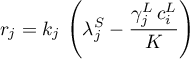
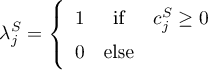
with
Variables
The molar rates for both domains are given as
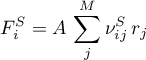
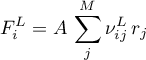
Since the heat transport associated with the mass transport is implicitly accounted for in the model equations of the associated balance component the energy flow rates become


Ports
Conserving
Liquid 1 conserving port
Port_B1 = Liquid; %
Liquid 2 conserving port
Port_B1 = Gas; %
Input
Physical signal that represents the surface area
Ain = {0,'m^2'};Dependencies: The port is only visible when
areaInputis set toOn.
Parameters
Options
Option to select area input
areaInput = OnOff.Off;
Off|On
Geometry
Surface Area
A0 = {0,'cm^2'};Dependencies: The parameter is only visible when the option
areaInputis set toOff.
Stoichiometry
Stoichiometric coefficients for solid domain
nu_S = {[-1;0],'1'};Note Initially only one equilibrium is considered. When the number of individual equilibria is increased, the size of the array must be adjusted accordingly.
Stoichiometric coefficients for liquid domain
nu_L = {[1;0],'1'};Note Initially only one equilibrium is considered. When the number of individual equilibria is increased, the size of the array must be adjusted accordingly.
Thermodynamics
Equilibrium constant
K0 = {1,'1'};Note Initially, only one equilibrium is considered. When the number is increased, the size of the array must be adjusted accordingly.
Kinetics
Rate constants
k = {0,'mol/(m^2*s)'};Note Initially only one equilibrium is considered. When the number of individual equilibria is increased, the size of the array must be adjusted accordingly.
Nomenclature
 |
area |
 |
molar flow rate of species Ai |
 |
molar enthalpy of species Ai |
 |
equilibrium constant |
 |
rate constant |
 |
total number of species |
|
number of equlibria |
 |
pressure |
 |
mass transfer rate |
 |
universal gas constant |
 |
temperature |
 |
mole fraction of species Ai |
 |
energy flow rate |
 |
activity coefficient of species Ai |