RateEG
 Chemical Reactor Design Toolbox Reference Manual
Chemical Reactor Design Toolbox Reference Manual ChemReactorDesign.Basic.Liquid.Rates.RateEG
Description
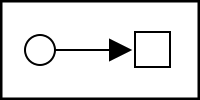
The component determines the molar fluxes due to a heterogeneous electrochemical reaction involving species in the gas and liquid phase
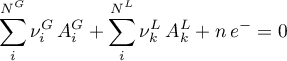
using a power law rate expression

with

and

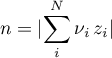
The area of the electrode is chosen as reference frame.
The concentrations are obtained from the mole fractions and the temperature dependent molar volumes (c.f. getConc).
Temperature Dependent Parameters
Rate Constant

Open Loop Potential

Overpotential

Comments
Generally, the reaction is regarded to be reversible. Thus, the individual orders of reaction are calculated from the provided stoichiometric coefficients to ensure equivalence between thermodynamics and kinetics.
Variables
The molar fluxes for the liquid phase are obtained as

and for the solid phase

Since the heat of reaction, i.e. the energy change resulting from the change in composition, is implicitly accounted for in the balance equation of the respective volume component, it holds

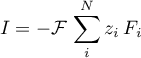
The associated currrent is obtained as
Ports
Conserving
Liquid conserving port
Port_B_L = Liquid; %
Gas conserving port
Port_B_G = Gas; %
Electrical conserving ports
Port_p = Electrical; %
Port_n = Electrical; %
Input
Physical signal that represents the area
A = {0,'m^2'}; % A
Parameters
Options
Option to select calculation of the open loop potential
calculate_U0 = OnOff.Off;
On|Off
Kinetics
Frequency Factor
kfinfA = {0,'mol/(cm^2*s)'};Activation Energy
Ea = {0,'kJ/mol'};Factor of Symmetry
alpha = {0.5,'1'};
Thermodynamics
Open Loop Potential
U0 = {0,'V'};The parameter is only visible when the option
calculate_U0is set toOn.
Liquid
Stoichiometric Coefficients
nu = {[-1; 0],'1'};Note Initially only two species are considered. As the number of species can be changed via the properties dialogue, the size of the array must be adjusted accordingly.
Solid
Stoichiometric Coefficients for Gas Phase
nu_G = {[1;0],'1'};Notes Initially for the solid phase only two species are considered. As the number of species can be changed via the properties dialogue, the size of the array must be adjusted accordingly.
Nomenclature
 |
area |
 |
activity of species Ai |
 |
concentration of species Ai |
 |
activation energy |
 |
molar flow rate of species Ai in liquid phase |
 |
molar flow rate of species Ai in gas phase |
 |
Gibbs free energy of species Ai |
 |
current |
 |
reaction rate constant |
 |
total number of species in the liquid phase |
 |
total number of species in the gas phase |
 |
pressure |
 |
reaction rate |
 |
universal gas constant |
 |
temperature |
 |
potential |
 |
potential |
 |
mole fraction of species Ai |
 |
charge of species Ai |
 |
Faraday constant |
 |
symmetry factor |
 |
overpotential |
 |
stoichiometric coefficient of species Ai |
 |
stoichiometric coefficient of species Ai in gas phase |
 |
order of reaction of species Ai (forward reaction) |
|
order of reaction of species Ai (forward reaction) |
 |
activity coefficient of species Ai |
 |
energy flow rate in liquid phase |
 |
energy flow rate in gas phase |