Cardano
 Chemical Reactor Design Toolbox Reference Manual
Chemical Reactor Design Toolbox Reference Manual ChemReactorDesign.Basic.Gas.Functions.Cardano
The function solves the cubic equation

Using Cardano's formula (Jürgen Gmehling and Michael Kleiber and Bärbel Kolbe and Jürgen Rarey, 2019), this type of equation can be solved analytically.
With the abbreviations

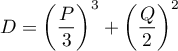
the discriminant can be determined as
For  , the equation of state has one real solution:
![\begin{equation*}
z = \left[\sqrt{D}-\frac{Q}{2}\right]^{1/3}-
\frac{P}{3 \, \left[\sqrt{D}-\frac{Q}{2}\right]^{1/3}} -
\frac{U}{3}
\end{equation*}](ltximg/Cardano_dcf3d5deabfe0f6d56f3acb6d9a04b3e794b62e6.png)
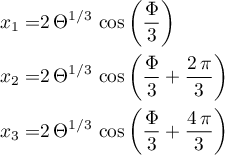
For  , there are three real solutions. With the abbrevations

they can be written as